
Shared Decision-Making: Good Healthcare Starts with Better Conversations
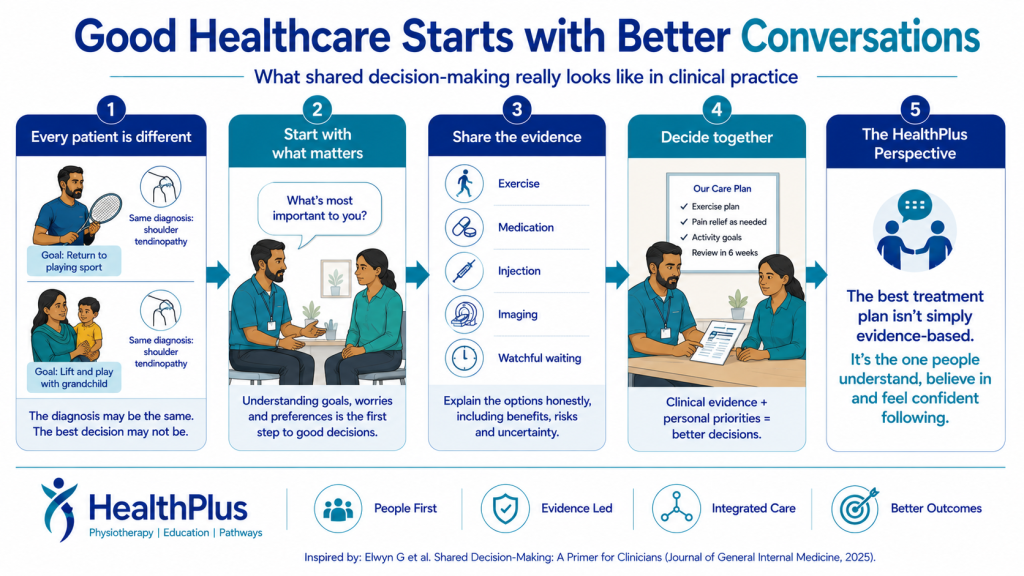
Most people want to be involved in decisions about their health. Not because they expect to know more than their clinician, but because they want to understand what’s happening, what their options are, and what those choices might mean for their everyday life.
It sounds straightforward. In reality, it isn’t always easy. Appointments are busy. There may be uncertainty around a diagnosis or more than one reasonable treatment option. Some people want to make decisions themselves, while others would rather be guided by their clinician.
A recent international paper published in the Journal of General Internal Medicine offers a practical reminder that shared decision-making isn’t about handing responsibility to patients. It’s about making decisions together.
It’s more than offering a choice
Shared decision-making is sometimes misunderstood as simply presenting a list of options and asking the patient to choose. The paper argues that it’s much more than that.
It begins with understanding what matters most to the individual sitting in front of you. Their lifestyle, work, family responsibilities, previous experiences, concerns and goals all influence which option is likely to be the right one.
Clinical evidence remains essential. But evidence alone doesn’t make decisions. People do.
There isn’t always one “right” answer
Many musculoskeletal conditions can be managed in different ways. A person with shoulder pain may choose to begin with rehabilitation, while another may prefer an injection after discussing the benefits and limitations of each approach.
Someone with knee osteoarthritis might prioritise staying active enough to play with their grandchildren. Another may simply want to walk to the local shops without pain.
The diagnosis may be the same. The best decision may not be. That’s why understanding the person’s priorities is just as important as understanding the condition itself.
Good conversations build confidence
One of the strongest messages from the paper is that shared decision-making is an ongoing conversation rather than a single event.
People need time to ask questions, think about information and sometimes discuss options with family members before making a decision. The goal isn’t necessarily complete agreement. It’s ensuring people feel informed, supported and involved throughout the process.
When patients understand why a treatment has been recommended and feel their concerns have genuinely been heard, they’re often more confident in following that plan.
What this means for MSK care
In musculoskeletal practice, this approach matters every day. Rehabilitation works best when it reflects what matters to the individual. The most effective exercise programme isn’t always the most complex one. It’s the one someone feels confident they can continue.
The same applies to decisions about imaging, injections, activity modification or returning to work. Good clinical care combines evidence with the person’s own priorities.
From a HealthPlus Perspective
At HealthPlus, we believe better healthcare begins with better conversations. Clinical expertise remains fundamental. But equally important is understanding what matters to the person in front of us.
Shared decision-making isn’t about asking patients to make difficult clinical decisions on their own. It’s about combining professional knowledge with personal priorities to create a plan that feels realistic, meaningful and achievable.
Because the best treatment plan isn’t simply the one supported by evidence. It’s the one people understand, believe in and are confident enough to follow.
References
- Elwyn G, Gulbrandsen P, Leavitt H, et al. Shared Decision-Making. A Primer for Clinicians. Journal of General Internal Medicine. 2025;40(16):3889-3899.
- National Institute for Health and Care Excellence (NICE). Shared Decision Making (NG197). 2021.
- General Medical Council. Decision Making and Consent. 2020.
About the Author
Nihar Palan is an Advanced Practice Physiotherapist with nearly 20 years of clinical experience in musculoskeletal healthcare. Through HealthPlus, he supports Primary Care Networks and healthcare organisations to improve MSK pathways while promoting evidence-based, person-centred care that helps people make informed decisions about their health.
Disclaimer
This article is intended for education and general information only. It should not replace individual medical advice. Decisions about assessment or treatment should always be made in partnership with an appropriately qualified healthcare professional, taking into account your individual circumstances, preferences and health needs.
