Hip pain. Knee pain. Shoulder pain. One of the first questions patients ask is simple: “Do I need a scan?” And if we’re honest, sometimes the system nudges us in that direction too. But step back for a moment. Because the issue isn’t imaging itself. It’s how and when we use it. Imaging isn’t the […]
Why MSK Reform Is a Cultural Change Challenge, Not Just a Workforce One
Introducing new MSK roles does not automatically create system reform. Culture determines whether new pathways succeed. FCP models often underperform not because of capability, but because of culture. MSK reform challenges long-standing habits around referral patterns, ownership of risk, and perceptions of professional roles. Without cultural alignment:• GPs may under-utilise FCP expertise• FCPs may be […]
Hip Osteoarthritis in 2025: What the New Clinical Guideline Means for Primary Care and MSK Pathways
Hip osteoarthritis is one of the most common causes of persistent pain and mobility loss in adults. It’s also a major driver of GP consultations, imaging requests, referrals and surgical pathways across the NHS. The newly updated 2025 Clinical Practice Guideline for Hip Osteoarthritis, published in the Journal of Orthopaedic & Sports Physical Therapy, brings together […]
Why MSK Care Fails Without Integration with Community and Social Prescribing
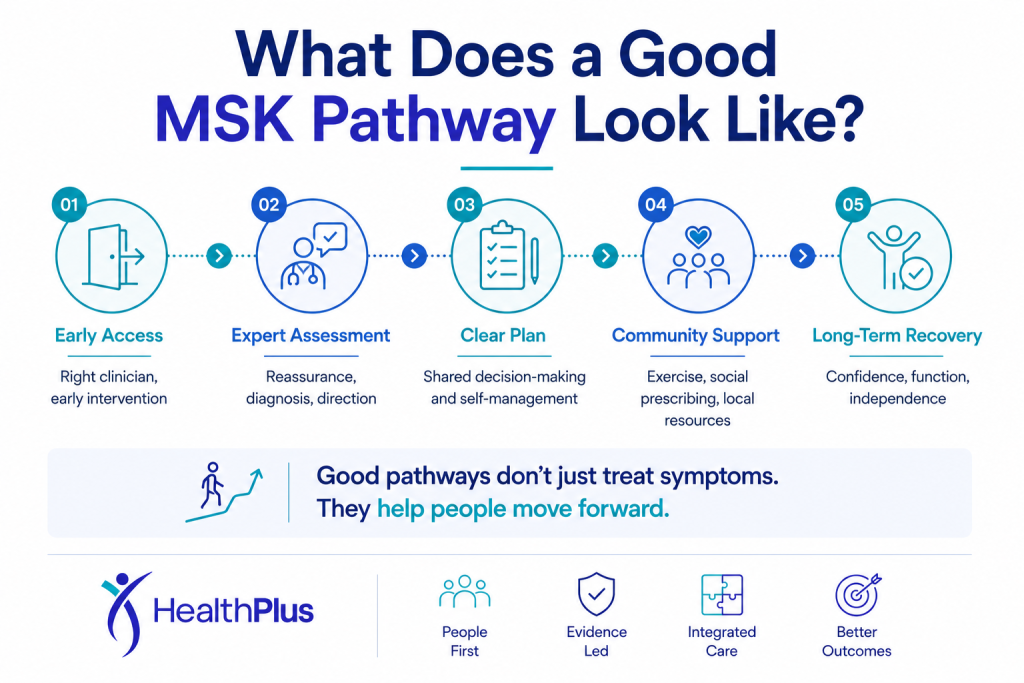
Clinical MSK care alone rarely sustains long-term recovery. What happens after the appointment matters just as much as what happens during it. Many MSK pathways succeed clinically but fail behaviourally. Patients receive good advice, reassurance, and exercise guidance — yet struggle to maintain movement once discharged. The gap is not clinical skill. It is pathway […]
Why MSK Pathways Must Be Designed for Population Need — Not Just Demand
MSK workload in primary care is often described as a volume problem. In reality, it is a population-pattern problem. PCNs experience MSK demand differently based on deprivation, employment patterns, ageing populations, long-term conditions, and physical inactivity. Yet MSK pathways are frequently designed as uniform services — reactive to appointment volume rather than responsive to population […]
Why System Design Determines the Success of First Contact Physiotherapy in PCNs
First Contact Physiotherapy is now well established across primary care. Yet outcomes vary significantly between PCNs. The difference is rarely the individual clinician — it is the system design around them. Across PCNs, FCP impact is often discussed in terms of workforce performance, productivity, or appointment numbers. This framing misses the real determinant of success: […]
First Contact Physiotherapists as Clinical Risk Managers in MSK Pathways
MSK care is often labelled “low risk.” In reality, it involves diagnostic uncertainty, safeguarding considerations, and complex behavioural risk. FCPs don’t just treat pain. They manage risk at the front door of primary care. MSK presentations involve:• Red flag screening• Diagnostic uncertainty• Safeguarding awareness• Behavioural risk (fear, avoidance, dependency) Without strong governance, early MSK access […]
Why Early Access to MSK Expertise Matters More Than Treatment Intensity
MSK pathways often focus on treatment intensity — but access to the right clinician at the right time is the real lever. Systems frequently respond to MSK demand by increasing appointment volume, adding modalities, or extending treatment sessions. While well-intentioned, this doesn’t address the root issue. Delayed access creates:• Fear-driven inactivity• Dependency on investigations• Repeat GP attendances• Avoidable escalation […]
Why MSK Reform Starts at First Contact in Primary Care
The quality of MSK care is often decided before any treatment begins. The first clinical decision — who sees the patient, how risk is assessed, and whether movement is encouraged early — shapes everything that follows. When MSK pathways struggle, it’s rarely because clinicians lack skill.It’s because the first point of contact is misaligned with […]